Annual, Cat 1, and Cat 5: Elevator Test Tags Explained
Walk into any machine room and you'll find a cluster of small metal tags on or beside the controller. They are not decoration — they are the elevator's testing record, required by the maintenance and inspection provisions of ASME A17.1 (Sections 8.6, 8.10 and 8.11) and enforced by the jurisdiction. This guide explains which tag records which test, what has to be on each one, and how they have to be made.
Why the test record lives on a metal tag
ASME A17.1 requires a periodic test record for all periodic tests — showing the applicable code requirement, the date performed, and the name of the person or firm performing the test — to be installed so it is readily visible and adjacent to or securely attached to the controller of each unit, in the form of a metal tag. Acceptance test results likewise have to be kept as a permanent on-site record, and a permanently attached test tag at the controller is the accepted way to meet that requirement on units installed under the 2013 edition and later.
The reasoning is practical. An inspector arriving for a periodic inspection needs to know, before anything else, when the last Cat 1 was done and by whom, and when the last Cat 5 is due. A log book in a building office does not help in the machine room; a tag on the controller does.
Test categories, in plain terms
Periodic tests are grouped into categories by frequency. The code leaves the intervals to the Authority Having Jurisdiction, and many jurisdictions adopt the recommended schedule in the code's Nonmandatory Appendix N. Every periodic test, whatever the category, must be witnessed by the jurisdiction's inspector or a person the jurisdiction authorizes.
| Category | Typical interval | What it covers |
|---|---|---|
| Category 1 | Typically every year | The routine test series (safeties and standby power are tested with no load in the car). Electric: oil buffers, safeties (governor tripped by hand at slowest speed), governors, slack-rope devices, terminal stopping devices, firefighters' emergency operation, standby power, door closing force and speed, broken rope/tape switch, ascending car overspeed and unintended movement, and the items added edition by edition (traction-loss detection, occupant evacuation, emergency communications, earthquake operation, door reopening devices, and so on). Hydraulic: relief-valve setting and system pressure test, cylinder and pressure piping, flexible hoses, pressure switch, plunger gripper, plus the door, power, and safety-device items. |
| Category 3 | Typically every 3 years | Hydraulic elevators only: exposing and examining the unexposed piston rods of roped water-hydraulic units, and cleaning, internally examining, and hydrostatically testing pressure vessels. |
| Category 5 | Typically every 5 years | The loaded, full-speed tests. Electric: car safeties and governors with rated load in the car at rated speed, oil buffers, driving-machine brake, emergency terminal stopping and speed-limiting devices, leveling zone and speed, braking system and traction, and the emergency brake (the brake and traction tests run at 125% of rated load on passenger elevators). Hydraulic: governors, safeties, and oil buffers where provided (roped-hydraulic), coated-rope magnetic flux test, rope fastenings, plunger grippers, overspeed valves, and Class C2 freight loading. |
Because the items on a Cat 1 list depend on which edition the unit was installed or altered under — a 2019-edition unit has test items a 2007-edition unit does not — the tag itself lists the test items by requirement number with a date column beside each, so the record stays legible as items are added. With approval of the Authority Having Jurisdiction, the code also allows alternative test methods for several Category 5 tests (car safeties, oil buffers, driving-machine brake, braking system and traction, and the emergency brake); when those are used, the test tag has to say so.
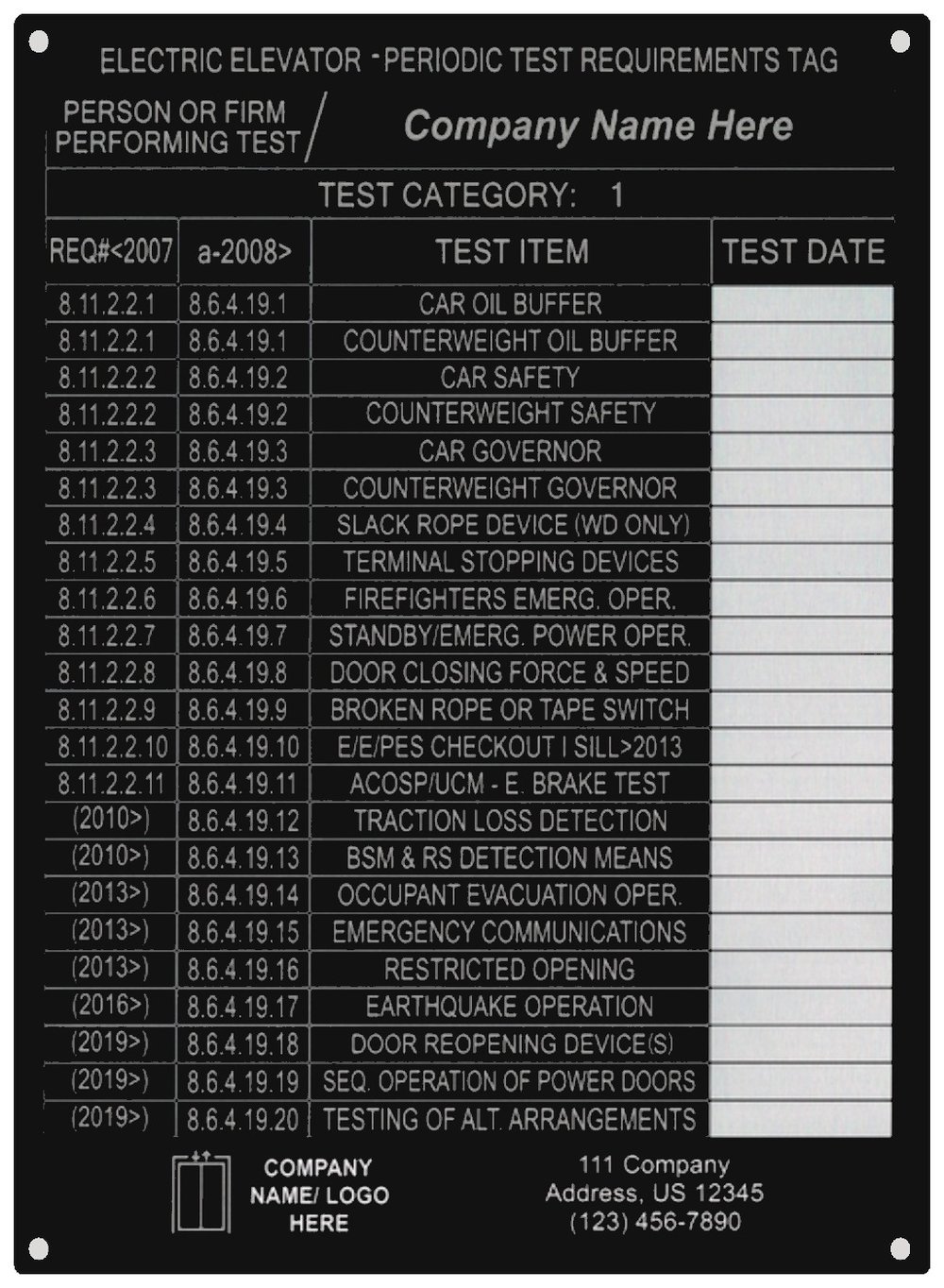
The tags you'll find at the controller
- Acceptance test tags — record the acceptance inspection and tests when a new or altered unit goes into service (Section 8.10). Separate versions exist for electric and hydraulic machines, and small-format traction and hydro acceptance tags for tight controllers.
- Annual / periodic tags — the running record of routine periodic tests, typically with five years of date lines. See the Annual 5 Year Tag and the Mandated Inspection Tag.
- Category 1 tags — the itemized yearly test record: electric and hydraulic Cat 1 periodic test tags, or the general electric / hydraulic periodic test tags.
- Category 5 (and Cat 3) tags — the five-year full-load record on traction units, and the combined Cat 3 & 5 tag for hydraulics.
- Governor and safety test tags — record governor trip tests and car safety tests on traction units. Note the code also requires a permanent tag on the governor itself with the trip-speed test data, and one on each oil buffer with its test date, in addition to the record at the controller: Governor Test, Governor Safety, and Traction Test Date tags.
- Hydraulic test tags — Hydro Test, Hydro Pressure, and Hydro Bypass data tags for the pressure and relief-valve records.
What must be on a test tag
The code requires three things on the periodic test record, and a well-designed tag adds a few more so the record is actually useful in the field:
| Field | Required? |
|---|---|
| Applicable code requirement(s) — the requirement number of each test performed | Required |
| Date(s) performed | Required |
| Name of the person or firm performing the test | Required |
| Name of the inspector who witnessed the test, with inspector ID number and certifying organization | Required on acceptance test tags (Section 8.10), which must be permanently attached to the controller |
| Note if an alternative test method was used (where the code's alternative testing provisions were applied) | Required when applicable |
| Test category (1, 3, or 5) | Standard practice |
| Test item description beside each requirement number, so the tag reads without the code book open | Standard practice |
| Unit / car ID | Standard practice |
| Testing firm's logo, address, and phone | Optional — but it is your company's name the inspector sees for the next five years |
Material, lettering, and mounting rules
Test tags are “marking plates and tags” under Section 8.13, and the rules are different from data plates in one important way. Marking plates and tags must be made of metal or another durable material designed to last the life of the equipment, securely attached so they resist a 15-lb (65 N) pull (adhesive, where used, meeting UL 969 or the CSA equivalent), and provided with preprinted permanent letters and figures at least 3 mm (1/8 in.) high. But unlike a data plate, the code permits writing instruments, stamping, and scratching to apply the lettering and figures on a marking tag — which is what makes a fill-in test tag legitimate. One size exception: for the permanent on-site acceptance test record required by Section 8.6 on units installed under the 2013 edition and later, the code allows a test tag with lettering as small as 1.6 mm (1/16 in.), which is why a full itemized acceptance tag fits on a manageable plate.
Etched aluminum handles all of this: the preprinted headings, requirement numbers, and item descriptions are permanently etched into the metal at code height, and the date column is left as bright aluminum so the mechanic can stamp, scratch, or write in the date and initials after each test. Periodic test tags mount on or next to the controller; acceptance test tags are permanently attached to it. Use 3M VHB adhesive or the corner holes.
Stocking the truck
In our experience a missing or unreadable test tag is a routine write-up: it leaves the inspector unable to confirm the unit's testing history, and it is one of the cheapest deficiencies to prevent. Service companies typically keep a supply of the common tags on the truck — Cat 1 electric and hydraulic, Cat 5, annual, governor — and order acceptance tags per job. CodePlates sells the full family, laser-etched with your company name and contact information, with volume pricing and nationwide shipping from Stevensville, MD.
Every CodePlates plate is laser-etched into black anodized aluminum (0.040" stock, finished with 3M VHB adhesive or drilled for screws), so the lettering is in the metal, not on it. Orders are configured online and ship nationwide from Stevensville, Maryland.
Frequently asked questions
What is an elevator test tag?
A metal tag mounted at the controller that records the periodic (and acceptance) tests performed on that elevator: the code requirement tested, the date, and the person or firm that did it. ASME A17.1 requires the periodic test record to be in the form of a metal tag, readily visible and attached to or adjacent to the controller.
What is the difference between Category 1 and Category 5 tests?
Category 1 is the routine (typically annual) test series — safeties tested with no load in the car, governor, buffers, terminal stopping devices, firefighters' service, standby power, door force and speed, and related items (relief valve and pressure tests on hydraulics). Category 5 is the typically five-year test with rated load in the car that verifies the safeties and governor at rated speed, plus the buffers, driving-machine brake, and traction (brake and traction at 125% of rated load on passenger elevators). Hydraulic units also have a Category 3 test, typically every three years, for pressure vessels and unexposed piston rods. Intervals are set by the jurisdiction; many follow the code's nonmandatory recommended schedule.
What must be written on a periodic test tag?
At minimum: the applicable code requirement(s) tested, the date(s) performed, and the name of the person or firm performing the test. If an alternative test method was used, the tag must say so. Most tags also show the test category, a description of each item, and the unit ID.
Can a test tag be a sticker or a paper label?
No. ASME A17.1 requires the periodic test record to be a metal tag, and marking plates and tags in general must be metal or another durable material designed to last the life of the equipment, securely attached, with preprinted permanent lettering at least 3 mm high. Etched aluminum is the standard.
Can the mechanic write or stamp the test date on the tag?
Yes. For marking plates and tags, the code permits writing instruments, stamping, and scratching to apply lettering and figures, so the date and initials can be filled in on site. The tag must still carry preprinted permanent lettering at least 3 mm high — on an etched tag that is the headings and requirement numbers. This is different from data plates (including the code data plate and alteration tag), where writing and stamping are not permitted.
Where do elevator test tags go?
Readily visible, adjacent to or securely attached to the controller of each unit. Each elevator gets its own tag or set of tags.
Do I need a different test tag for hydraulic and traction elevators?
Yes. The test items and requirement numbers differ. Hydraulic Category 1 adds the relief-valve setting, system pressure, cylinder, piping, hose, and pressure-switch tests, and hydraulic Category 5 covers overspeed valves and plunger grippers; electric Category 5 covers the driving-machine brake, braking system, and traction. Order the electric or hydraulic version to match the unit.
Why do the tags list two requirement numbers for each item?
The periodic test requirements were moved within the code and renumbered around the 2007 edition of A17.1 and its 2008 addenda. Listing both the older and the current requirement numbers lets one tag serve units installed under either numbering scheme, which is common in a mixed-age portfolio.
This guide is general information for the elevator trade, not code text or legal advice. Requirements vary by jurisdiction and code edition — always confirm with the ASME A17.1 edition adopted by your Authority Having Jurisdiction. Updated September 2026.