Elevator Alteration Tags Explained: What ASME A17.1 Section 8.7 Requires
Every elevator modernization ends at a small metal tag in the machine room. Section 8.7 of ASME A17.1 governs alterations — changes to an elevator that go beyond maintenance, repair, or replacement in kind — and every alteration has to be recorded, permanently, on the unit's code data plate. In the trade that record is called the elevator alteration tag (also alteration plate, alteration data tag, or alteration code data plate — same thing).
What counts as an alteration
ASME A17.1 draws a line between four kinds of work. Maintenance is routine examination, lubrication, cleaning, and adjustment. A repair is reconditioning or renewal of parts to keep the equipment in compliance. A replacement substitutes a device or component, in its entirety, with one that is basically the same as the original. An alteration is any change to the equipment other than those three — and Section 8.7 spells out, item by item, which changes trigger which code requirements. Typical alterations include:
- Controller replacement (unless it is replaced with equipment equivalent to the original make and model because of damage or loss, to match the rest of the group)
- Replacement of a complete driving machine
- Increase in rated load; increase or decrease in rated speed
- Change in rise, number of landings, or hoistway entrances
- Addition of, or alteration to, power operation of hoistway doors
- Hydraulic equipment, valve, pressure piping, and tank changes on hydraulic units
- Suspension means changes (rope type, number, or size)
- Car changes that increase the deadweight enough to raise the deadweight-plus-rated-load total by more than 5%
The governing rule is that an altered installation must, as a minimum, conform to the code that was in effect when it was installed and to the code requirements for the alteration in effect at the time of the alteration — plus ASME A17.3 where the jurisdiction has adopted it. Where an alteration is made, acceptance inspection and tests are required on the altered work, and Section 8.7 states directly that a code data plate must be provided as required by Section 8.9.
Why alterations need their own tag
An alteration is performed under the code edition in effect when the alteration is made — not the edition the elevator was installed under. A traction unit installed in the late 1990s that received a new controller in 2016 is inspected under its original installation edition for the original equipment, and under the edition the jurisdiction had adopted in 2016 for the controller and the operation it governs. The alteration tag is the only code-required record of that split on the controller itself. Without it, the inspector has to guess, and the mechanic on the next callback has no idea what was and was not touched.
On a modernized unit the elevator alteration tag is, in effect, the elevator's service history in metal.
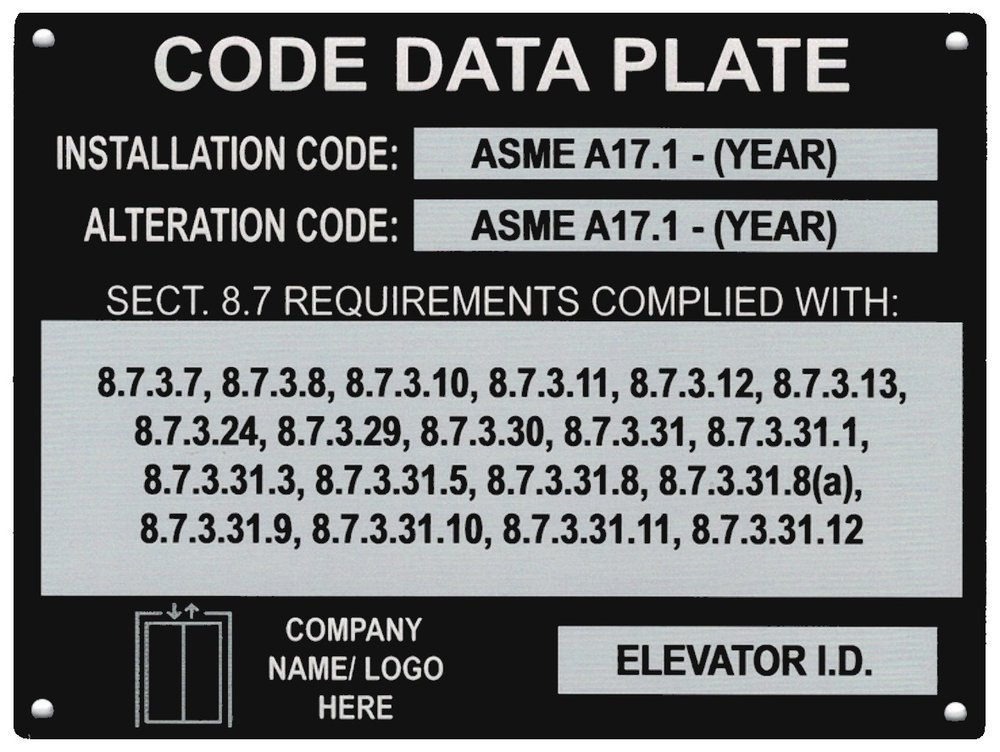
What the elevator alteration tag has to record
| Field | What goes there |
|---|---|
| Installation code | The code and edition the unit was originally installed under (e.g., ASME A17.1-1996). This never changes, no matter how many times the unit is altered. |
| Alteration code | The code and edition in effect at the time of the alteration (e.g., ASME A17.1-2019). Each separate alteration gets its own line. |
| Section 8.7 requirements complied with | The list of Section 8.7 requirements the alteration was performed under — the scope of the job expressed in code language. This is the field inspectors read most closely, because it says exactly which items of the modernization must meet the newer edition. |
| SIL rated device statement | If the alteration introduced SIL rated devices, the plate (or an adjacent plate) must state “Installation contains SIL rated devices.” |
| Elevator ID | Car number or unit ID so the plate is matched to the right controller. |
| Contractor name / logo | Optional, and standard practice: the company that performed the alteration. |
The alteration tag is part of the code data plate, so the same physical rules apply: mounted in plain view on or in the controller or main line disconnect, permanently legible lettering at least 3.2 mm (1/8 in.) high, on a durable material designed to last the life of the equipment, and — when mounted outside the controller — protected against paint, oil, and grease. See the code data plate guide for the full material and lettering rules.
Electric vs. hydraulic
Section 8.7 has separate sub-sections for electric (traction) elevators and hydraulic elevators, and the requirement numbers differ between them. That is why elevator alteration tags are supplied in electric and hydraulic versions rather than one generic form — the requirement numbers differ throughout, and the hydraulic list adds items (hydraulic equipment, valves and pressure piping, tanks) that do not exist on a traction unit. Ordering the wrong version is the most common alteration tag mistake we see; the site asks you to pick electric or hydraulic first for that reason.
Blank vs. custom-etched
There are two ways to get an alteration tag onto the controller:
- Blank alteration tag — the headings and boxes are etched, and the mechanic fills in the codes and requirement numbers on site. Fast and cheap to stock on the truck. The catch: the code data plate is a data plate under Section 8.13, and for data plates the code does not permit writing instruments, stamping, or scratching — the lettering must be engraved, etched, cast, or otherwise permanently applied (Section 8.9 itself lists stamped lettering as acceptable if it stays permanently legible, so a properly hand-stamped tag is a judgment call for the inspector). A blank completed in marker does not meet the requirement, and the person filling it in carries that responsibility.
- Custom-etched alteration tag — you supply the installation code, alteration code, the list of Section 8.7 requirements, the car ID, and your logo; the finished tag arrives with everything laser-etched and permanently legible. Nothing to fill in, nothing for the inspector to question.
Custom elevator alteration tags have historically been the slowest plate in the industry to procure — weeks of back-and-forth by email with an engraver. At CodePlates the electric and hydraulic custom alteration plates are configured online in minutes: you check the applicable Section 8.7 requirements from a list, type the codes and the car ID, upload a logo if you want one, review the etch preview, and order. Contractors who already use an in-house alteration checklist can upload the completed spreadsheet and the order form fills itself in. Blank alteration tags and the standard custom alteration tag are also available.
Units altered more than once
A unit that has been altered several times across different code editions needs the whole history recorded: the installation code, the first alteration, and each subsequent one. A Multi-Year Code Data Plate puts installation code plus first, last, and current alteration codes on one plate, with a box for the accumulated Section 8.7 requirements. It is the cleanest way to replace a controller-full of stacked, half-legible alteration tags with a single plate an inspector can read at a glance.
Ordering checklist
Have these in hand before you configure a custom elevator alteration tag and the order takes about five minutes:
- Electric or hydraulic — determines which requirement list you will see.
- Installation code edition — from the existing code data plate, the acceptance record, or the permit file.
- Alteration code edition — the edition adopted by the jurisdiction when the alteration was performed (usually the edition on the permit).
- Section 8.7 requirements complied with — from the alteration permit application or the engineer's scope; the site lists them by number so you can check them off.
- Elevator / car ID and the job or state ID number if your jurisdiction uses one.
- Company name or logo to etch in the corner, if wanted.
- Mounting — 3M VHB adhesive back, or corner holes for screws.
Every CodePlates plate is laser-etched into black anodized aluminum (0.040" stock, finished with 3M VHB adhesive or drilled for screws), so the lettering is in the metal, not on it. Orders are configured online and ship nationwide from Stevensville, Maryland.
Frequently asked questions
What is an elevator alteration tag?
An elevator alteration tag (also called an alteration plate or alteration data plate) is the permanent metal record of an alteration: the ASME A17.1 edition in effect when the alteration was made and the Section 8.7 requirements the work was performed under. Section 8.7 requires a code data plate per Section 8.9 whenever an alteration is performed, and the tag is mounted in plain view on or in the controller.
What is the difference between an alteration tag and a code data plate?
They are the same requirement seen from two angles. Section 8.9 requires one code data plate per unit showing the installation code and the code for every alteration. An alteration tag is the plate, or the addition to it, that carries the alteration information. On a unit that has never been altered, the code data plate shows only the installation code.
Does every elevator modernization need an alteration tag?
Yes. Any work that qualifies as an alteration under Section 8.7 — controller replacement (other than an equivalent make-and-model swap after damage or loss), driving machine replacement, an increase in rated load, a change in rated speed, and so on — must be reflected on the unit's code data plate along with the code edition it was done under. Ordinary maintenance, repair, and in-kind replacement do not.
What is the difference between an electric and a hydraulic alteration tag?
Section 8.7 has separate requirement lists for electric (traction) and hydraulic elevators, so the "requirements complied with" section differs: the requirement numbers are different throughout, and the hydraulic list adds hydraulic equipment, valve, pressure piping, and tank items that a traction unit does not have. Order the version that matches the unit.
Can a mechanic fill in a blank alteration tag in the field?
Blank alteration tags are sold for that purpose, but the code data plate is a data plate under Section 8.13, so the lettering has to be engraved, etched, cast, or otherwise permanently applied — writing instruments, stamping, and scratching are not permitted on data plates (though Section 8.9 lists stamped lettering as acceptable if permanently legible, so hand-stamping is an inspector's call). Marker or pen is out. If the data is known when you order, a custom-etched alteration tag avoids the issue entirely.
What if the elevator has been altered more than once?
Record each alteration and its code edition. A multi-year code data plate has lines for the installation code plus first, last, and current alteration codes and a box for all the Section 8.7 requirements, so the full history fits on one plate.
Where does the elevator alteration tag go?
In plain view, securely attached on or in the controller or main line disconnect for that unit — the same location as the code data plate, because it is the code data plate (or an addition to it).
How long does it take to get a custom elevator alteration tag?
At CodePlates the tag is configured online in minutes; production and shipping options, including rush, are shown at checkout. Tags ship nationwide from Stevensville, Maryland.
This guide is general information for the elevator trade, not code text or legal advice. Requirements vary by jurisdiction and code edition — always confirm with the ASME A17.1 edition adopted by your Authority Having Jurisdiction. Updated September 2026.