What Goes on an Elevator Code Data Plate?
The elevator code data plate is the first thing an inspector looks for, because it answers the question every inspection starts with: which edition of the code does this unit have to meet? This guide covers exactly what the plate has to say, where it has to be, how it has to be made, how it relates to elevator alteration tags, and what to do when one is missing.
What the code data plate is
ASME A17.1 (the Safety Code for Elevators and Escalators) has required every unit within its scope — elevators, escalators, moving walks, and the rest — to carry an individual Code Data Plate since the late-1990s editions; in every edition since 2000 the requirement lives in Section 8.9, which is devoted entirely to it and applies to new and existing equipment. Its purpose is simple: an elevator installed in 1985 and modernized in 2015 is not inspected wholesale to today's code. The original equipment is held to the 1985 edition, the modernized parts to the 2015 edition (plus ASME A17.3 where the jurisdiction has adopted it), and the plate is the permanent record that tells the inspector, the mechanic, and the consultant which requirements apply to what.
Without it, the inspector has no reliable way to know what edition to test against, which is why a missing plate is treated as a real deficiency and not a paperwork nit.
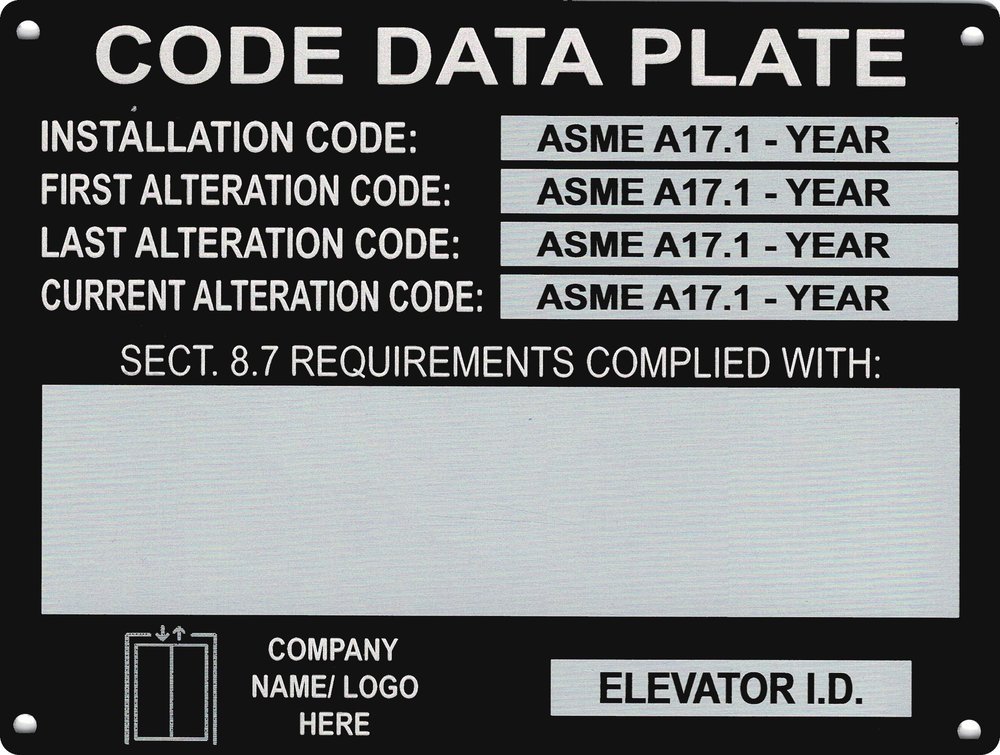
Field-by-field: what must be on the plate
Section 8.9 lists the required content. In practice a compliant plate carries the following:
| Field | What goes there |
|---|---|
| Installation code | The code and edition in effect when the unit was installed — for example, ASME A17.1-2013. This is the edition the original equipment is inspected and tested against. |
| Alteration code(s) | The code and edition in effect at the time of each alteration. A unit modernized twice under two different editions shows both. This is the information carried by an elevator alteration tag; multi-year plates provide first, last, and current alteration lines for exactly this reason. |
| Section 8.7 requirements complied with | The specific alteration requirements of Section 8.7 that the altered work was performed under. This is what ties each modernization to its scope — see our alteration plate guide. |
| SIL rated device statement | Where the installation or an alteration contains SIL rated devices, the wording “Installation contains SIL rated devices” must appear on the code data plate or on an additional plate mounted next to it. |
| Elevator / unit ID | Not a code-mandated field, but nearly universal — the plate is per unit, and the ID is how the inspector matches the plate to the car, permit, and test records. |
| Contractor name or logo | Also optional, and common: the company that performed the installation or alteration. Most contractors want their name on the machine-room record of their work. |
What is not on the code data plate: rated load, speed, car weight, and rope data. Those live on the capacity plate and crosshead data plate (below). Mixing them up is one of the more common reasons a replacement plate gets rejected.
Where the plate has to be
The code data plate must be in plain view and securely attached to each main line disconnect or controller. It is also acceptable to mount it inside the controller cabinet, provided it is in plain view when the controller door is open. Each unit gets its own plate — a bank of four cars means four plates, one per controller.
Escalators and moving walks need an additional code data plate near one of the starting switches on the exterior of the unit, so it can be read without opening anything.
Material and lettering rules
Section 8.9 and Section 8.13 together set the physical requirements, and they are strict enough that a printed label or hand-marked tag does not qualify:
- Permanent legibility. Letters and figures must be engraved, etched, cast, or otherwise applied so that they remain permanently and readily legible — or be raised or depressed so they stay legible if painted over, or be protected by a durable transparent covering. Section 8.13 does not permit writing instruments, stamping, or scratching to apply the lettering on data plates (Section 8.9 itself lists stamped lettering as acceptable if it stays permanently legible, so a hand-stamped plate is at best a judgment call for the inspector — a marker, pen, or scratch awl is out under either reading). Stick-on foil or paper labels are prohibited. Test tags are treated differently — see the test tag guide.
- Minimum character height of 3.2 mm (1/8 in.) for the letters and figures.
- Durable material designed to last the life of the equipment — metal, in practice.
- Secure attachment that resists a 15-lb (65 N) pull. Adhesive-attached plates must conform to UL 969 (or the CSA equivalent in Canada).
- Contamination protection. Plates not mounted inside the controller must either have a durable surface that lets paint, oil, grease, and adhesive be cleaned off without obscuring the data, or have characters raised or depressed at least 0.8 mm (1/32 in.) with a character stroke width of at least 0.5 mm, so they stay readable even if painted over. Plates exposed to weather or a chemical atmosphere need protection from deterioration.
Laser-etched anodized aluminum meets all of this cleanly: the etch removes the black anodized layer to expose bright metal, so there is no ink to fade, the surface wipes clean, and the plate outlasts the controller it is mounted on.
One relief for existing buildings: an existing code data plate that complied with the edition it was installed under, and still carries legible, accurate information, does not have to be replaced just to meet the current material and construction rules. The plate has to be replaced when it is missing, damaged, illegible, or wrong — not simply because it is old.
Code data plate vs. capacity plate vs. crosshead data plate
Three different plates get called “the data plate” in the field. They are separate requirements with separate locations:
| Plate | Location | Records |
|---|---|---|
| Code data plate (Section 8.9) | Controller / main line disconnect | Installation code edition, alteration code editions, Section 8.7 requirements, SIL statement |
| Capacity plate (Section 2.16.3) | Conspicuous position inside the car | Rated load in pounds and/or kilograms; one-piece load capacity and Class C2 loading data where applicable |
| Crosshead data plate (Section 2.16.3) | Car crosshead (or car top / in-car if no exposed crosshead) | Complete car weight, rated load and speed, suspension means data, manufacturer and year, rail lubrication instructions, counterweight overbalance range |
CodePlates makes all three: capacity plates, traction and hydraulic crosshead data tags, and the code data plates covered here.
Missing, damaged, or illegible: what happens
Section 8.6 of the code requires that damaged or missing signs and data plates be repaired or replaced as part of maintenance, and the code data plate is called out by name. In our experience a missing or unreadable plate is one of the most common inspection findings, and it stalls the whole compliance chain — the inspector cannot confirm which edition governs, so the unit cannot be cleanly signed off. Typical causes are paint overspray from a machine-room repaint, a controller replacement where the old plate went out with the old cabinet, and decades of oil film on a stamped plate.
The fix is a compliant replacement showing the correct installation and alteration code data, supplied by the building owner or the service contractor. The inspector will not fill it in for you.
Replacing a code data plate
- Establish the installation code edition. Look for the original plate, the acceptance test record, the permit file with the jurisdiction, or the original contract documents. The year the unit was installed points you to the edition adopted by the jurisdiction at the time — but the plate must show the edition actually in effect, not just the year.
- List every alteration and the edition it was done under. Each modernization, controller change, or capacity change since installation gets its own line. If the history is partial, a multi-year plate gives you room to record what is known.
- Choose the plate. For a unit with no alteration history, an Installation Code Data Tag or Code Data Tag is enough. For altered units, a Multi-Year Code Data Plate or a custom-etched elevator alteration tag records the full history.
- Order it etched, not blank, whenever the data is known. A blank plate filled in on site has to meet the same permanence rules, and a marker or scratch awl does not. Pre-etched plates arrive finished and remove the question.
- Mount it correctly: on or in the controller or main line disconnect, in plain view, with 3M VHB adhesive or screws through the corner holes.
Every CodePlates plate is laser-etched into black anodized aluminum (0.040" stock, finished with 3M VHB adhesive or drilled for screws), so the lettering is in the metal, not on it. Orders are configured online and ship nationwide from Stevensville, Maryland.
Frequently asked questions
Is an elevator code data plate required on older elevators?
Yes. Section 8.9 applies to all new and existing equipment within the scope of ASME A17.1, and the maintenance requirements in Section 8.6 call for the code data plate to be maintained. An existing plate that complied with the edition it was installed under and is still legible and accurate does not have to be replaced for material reasons alone. Adoption and enforcement dates vary by jurisdiction, but as a rule every unit under a modern A17.1 edition needs one, regardless of when the elevator was installed.
Where is the elevator code data plate located?
On or in the controller or main line disconnect for that unit, in plain view (inside the controller cabinet is acceptable if it can be read with the door open). Escalators and moving walks also need one near a starting switch on the outside of the unit.
What information is on a code data plate?
The code and edition in effect when the unit was installed, the code in effect at the time of each alteration, the applicable Section 8.7 alteration requirements complied with, and — where SIL rated devices are present — the statement "Installation contains SIL rated devices." Most plates also carry the elevator ID and the contractor's name or logo.
What is the difference between a code data plate and a capacity plate?
The capacity plate goes inside the car and states the rated load. The code data plate goes at the controller and states which code editions the unit was installed and altered under. The crosshead data plate is a third item, mounted on the car crosshead, carrying car weight, speed, rope data, and manufacturer information.
Can I write the code data on a blank plate with a marker or stamp?
Not with a marker, pen, or scratch awl. Code-required lettering on data plates must be engraved, etched, cast, or otherwise permanently applied, and Section 8.13 does not permit writing instruments, stamping, or scratching on data plates; paper or foil labels are prohibited. Section 8.9 does list stamped lettering as acceptable if it remains permanently legible, so a properly hand-stamped plate may be accepted by some inspectors — an etched aluminum plate removes the question.
How big do the letters on a code data plate have to be?
At least 3.2 mm (1/8 in.) high, and permanently legible. CodePlates etches all code-required text at or above this height.
How do I find the installation code edition for an old elevator?
Start with the original plate if any trace remains, then the acceptance test record, the jurisdiction's permit file, the original contract or drawings, and the manufacturer's records. The installation year narrows it down, but the plate must show the code edition that was actually adopted and in effect at the time of installation.
How fast can I get a replacement code data plate?
CodePlates plates are configured and ordered online in minutes with a free account, laser-etched to your unit's data, and shipped nationwide from Stevensville, Maryland. Rush production is available at checkout — rush orders received by 12:00 pm (noon) Eastern are made and shipped the next business day.
This guide is general information for the elevator trade, not code text or legal advice. Requirements vary by jurisdiction and code edition — always confirm with the ASME A17.1 edition adopted by your Authority Having Jurisdiction. Updated September 2026.